Writing · Recipe · Banking
The RM says approve. The numbers say decline.
Three problems credit analysts hit when AI drafts the memo, and the fix for each.
Credit analysts using AI to draft the memo on a loan request run into three problems:
- What can I safely upload?
- The memo believes the RM.
- The numbers shift between runs, so I can't sign them.
We put a fictional £1.2m request through Claude to see all three up close. Here's each one, with the fix.
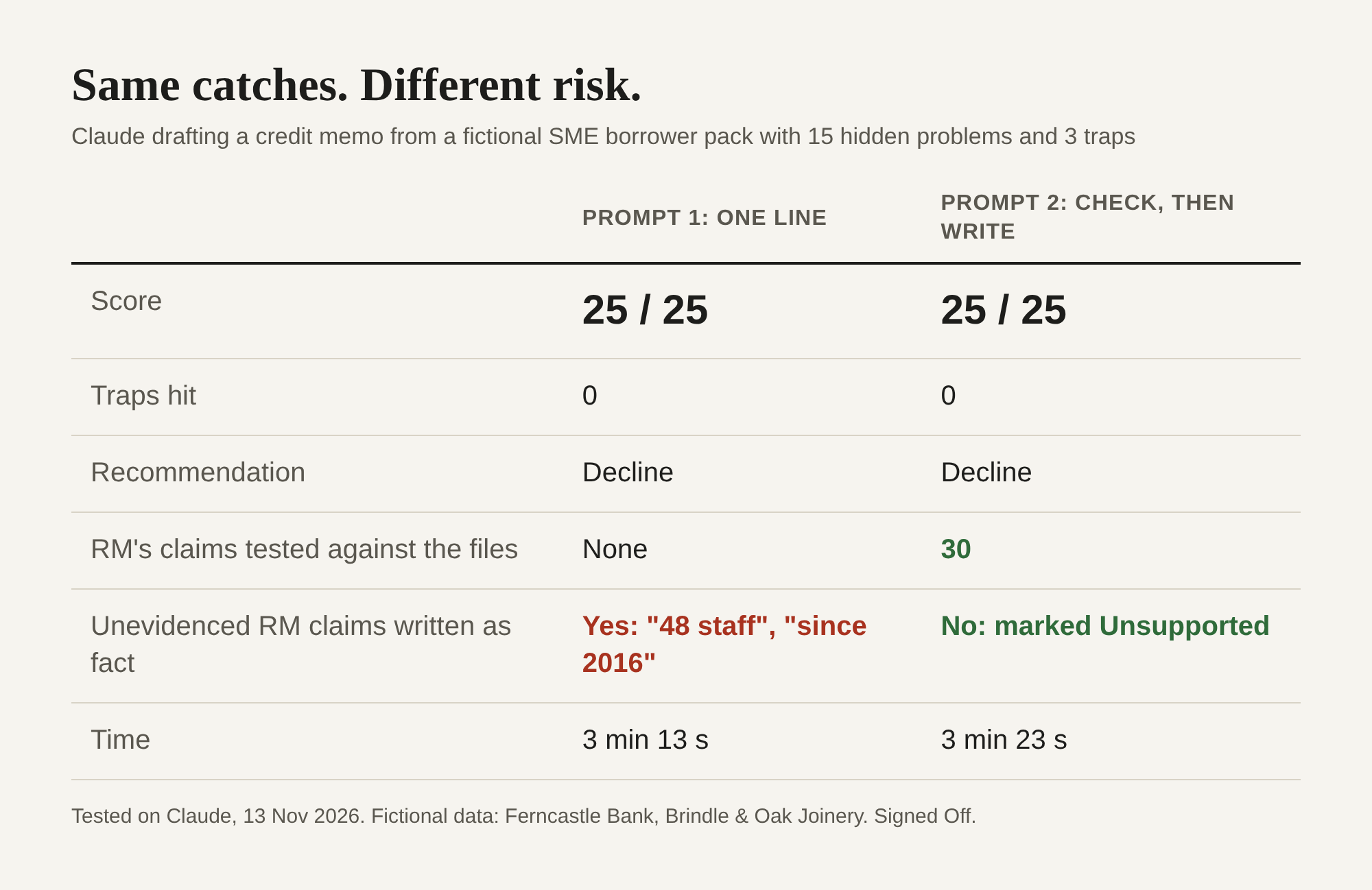
The good news first. Claude found all 15 problems we'd hidden in the pack, even from a one-line prompt.
The case
Ferncastle Bank and Brindle & Oak Joinery are fictional. The joinery firm wants £1.2m: a loan for a CNC machine, plus more on its revolver.
The RM says all covenants are met, 3.0x pro forma, within policy. Underneath, the covenant is already breached. Real leverage is 4.4x. Debt service cover is 0.66x.
We scored each memo out of 25 against a hidden answer key.
Problem 1: what can I safely upload?
The pack includes a KYC file with directors' names, dates of birth and home towns. That's personal data. It shouldn't go near an AI tool until your firm has done a data protection impact assessment.
The fix. Strip what the memo doesn't need before you upload. Dates of birth and home addresses go first. Neither test run needed them.
The check. Get the DPIA done for the use case, not for each memo. Then read your provider's retention terms. Some new models need 30-day retention unless zero retention is authorised (Anthropic release notes).
Problem 2: the memo believes the RM
Our one-line memo said the firm has 48 staff and has banked with us since 2016.
Neither fact is in the pack. Both came from the RM's note, and went into the memo in the bank's voice.
The model caught the covenant breach. It didn't question the small stuff. And the small stuff is what makes a memo sound checked.
The fix. Make it test the RM before it writes. Every claim gets marked Verified, Contradicted or Unsupported, with evidence. Our second prompt tested all 30 of the RM's claims. It contradicted 6 and found nothing in the pack behind 11 more.
Save this once as your team's memo checker: a Copilot agent, a Claude project, or an entry in your prompt library. Don't retype it.
You are a senior SME credit analyst preparing a memo for a Senior Credit
Officer. Attached: the RM's credit application, the customer's financials,
management accounts, projections and aged debtors, the existing facilities
and covenant certificate, the KYC record, our SME credit policy and our memo
template.

New loan pricing: SONIA [x]% + [margin]%. Pro forma on [date] balances.

Treat the RM application and the customer's covenant certificate as claims to
be tested, not facts. Work in two stages.

STAGE 1 — CHECK (show this as tables before the memo)
1. Facts table: pull every number you'll use from the source files, with the
   file it came from.
2. Recompute: net debt / EBITDA, interest cover and debt service cover, actual
   and pro forma, using the policy's definitions and the facility letter's
   definitions word for word. Show the workings. Where you have to assume
   something, say so and use a stated estimate.
3. Claims test: list every factual claim in the RM application and the
   covenant certificate. Mark each Verified / Contradicted / Unsupported, with
   the evidence.
4. Policy test: go through every section of the policy extract and mark Met /
   Not met / Needs info, citing the section.
5. Trend notes: margins, debtor and stock days, RCF utilisation, current-year
   trading vs projections. Explain causes where the files show them; say 'not
   explained in the pack' where they don't.

STAGE 2 — MEMO
Write the memo in the template's structure. The recommendation must follow
from Stage 1, not from the RM's view. Name every policy exception and who can
approve it. If something needs to happen before any approval (e.g. a breach, a
waiver, a KYC refresh), say so in Recommendation and Conditions. Don't raise
issues the files don't support; if a screening hit was properly discounted,
say that and move on. Keep the memo to roughly two to four pages.
Put Stage 1 in an appendix.
The check. Read every Contradicted and Unsupported row. Send them back to the RM before the memo goes anywhere.
Problem 3: the numbers shift between runs
Our two runs priced the new loan differently. One borrowed management's interest figure. The other assumed 8.5%. Both landed on 2.7x interest cover, by different routes. On a tighter case, that's the difference between pass and fail.
Pro forma leverage moves too, depending on which balance sheet you use: 4.38x on September balances, 4.34x on March.
The fix. Tell it the rate and the date. That's the second line of the prompt above. And make it tie every number to its source file, which Stage 1 does.
We re-ran it with the pricing stated. Interest cover came out at 2.90x. Still a fail, but now you can see exactly where every pound of interest comes from. That run also caught something the others missed: interest cover is already below the existing covenant on the last twelve months' numbers, before any new lending.
The check. Tick the facts table against the files. Re-run leverage, interest cover and debt service cover yourself. Then decide. The model recommends. You and your sanctioner sign.
What it saves
- Model: three and a half minutes (measured).
- Your check: about an hour (our estimate).
- Writing it from scratch: half a day to a day (estimate).
Before you use it at work
- SM&CR: the CRO (SMF4) owns credit policy. Your sanctioning mandate doesn't change.
- SS1/23: register it as a tool with a named owner. It drafts. It doesn't decide.
- EU AI Act: high-risk only if you're assessing individuals, like guarantors or sole traders.
Tested on Claude. Full fit box in the workbook.
Try it on your own tool
Would your firm's approved AI catch all 15? Run the pack through it and score it yourself.
Pack and answer key · Workbook: both prompts, scoring, failure modes, full fit box
If you want to run this with your credit team on your own packs, that's a half-day workshop. Hold the Pen runs this as a half-day workshop
The tested prompts, the fictional pack and the full regulatory fit box are in the Hold the Pen library. If you'd like it run on your own team's work, that's what Hold the Pen does.